Projects

Research into how data moves through space, and mechanical design for building where data actually lives. The 3D models below are the real CAD geometry — you can rotate them.

Space & Research

Traffic and Data Management, Multistrom Routing, Datacenter in Space,
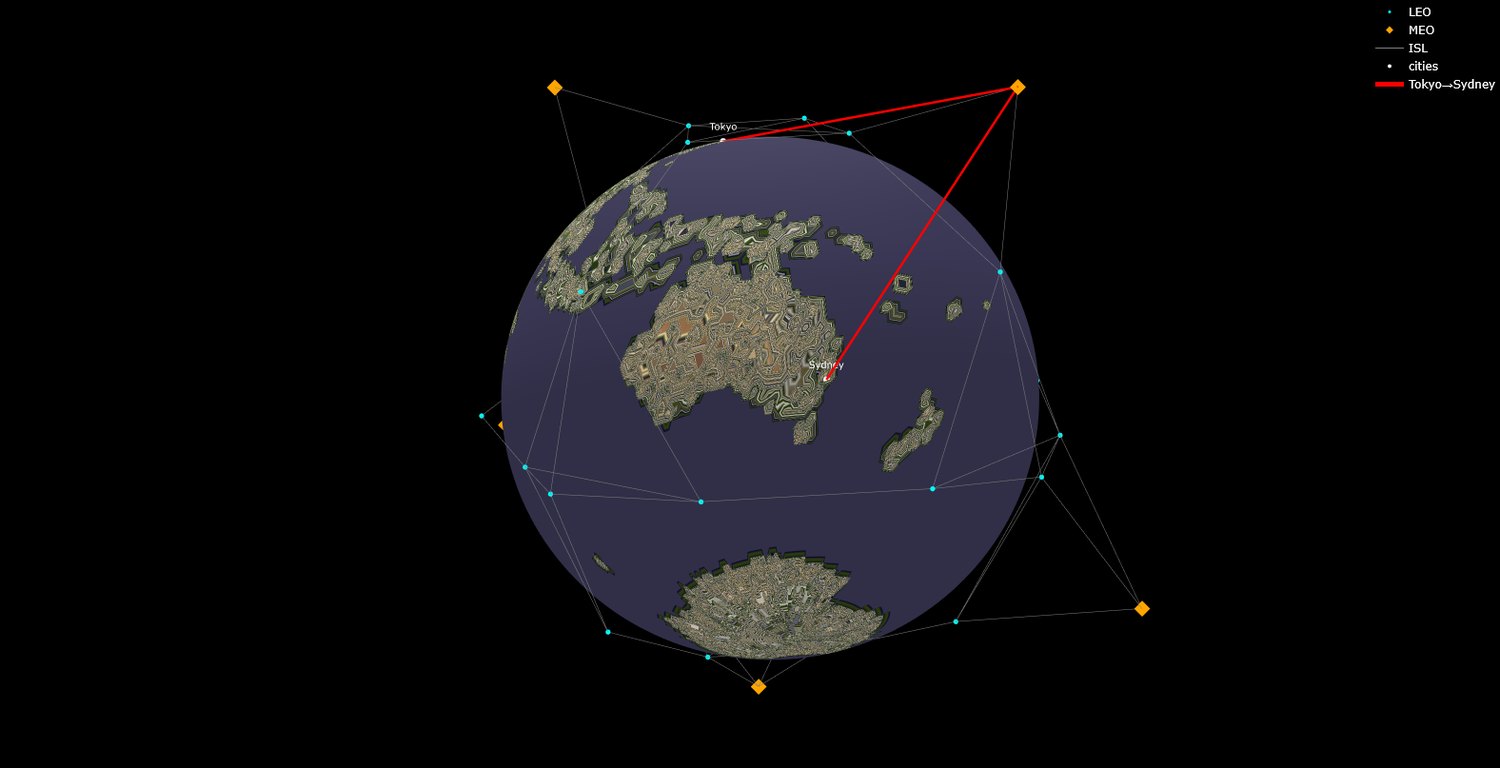
FAROS simulation showing satellites in LEO and MEO with inter-satellite links routing traffic between cities

FAROS — Multistrom Cluster of Satellites

A satellite communication network designed to carry data for cargo transfer and human missions in space, with the long-term aim of running autonomously. Instead of sending traffic along cables on the ground, FAROS keeps the whole network in orbit and organises it in stromata, so a packet can climb to a higher stroma and cross fewer satellites on its way.

I simulated the network in Python across several stromata and implemented Dijkstra's algorithm to find shortest paths over the inter-satellite link graph. I then built an interactive 3D model of Earth that lets you add or remove orbits, change altitude, and reconfigure the number of satellites, and watch the routing respond.

The simulations showed when a higher stroma is worth it: climbing there lowers latency only once each satellite needs more than 6.80 ms to process a packet. They also showed that between continents, any route that returns to the ground fails, so the network must be connected in orbit. Unlike seabed cables, an orbital network is also out of reach of the disturbances that can cut several cables at once.
Data Centre Engineering

I am the 3D designer for the Kirineos data centre at MTEL. I model the parts in SolidWorks, produce the manufacturing drawings, and send the CAD to factories where they are made. The models below are the actual production geometry, converted to STEP exports.

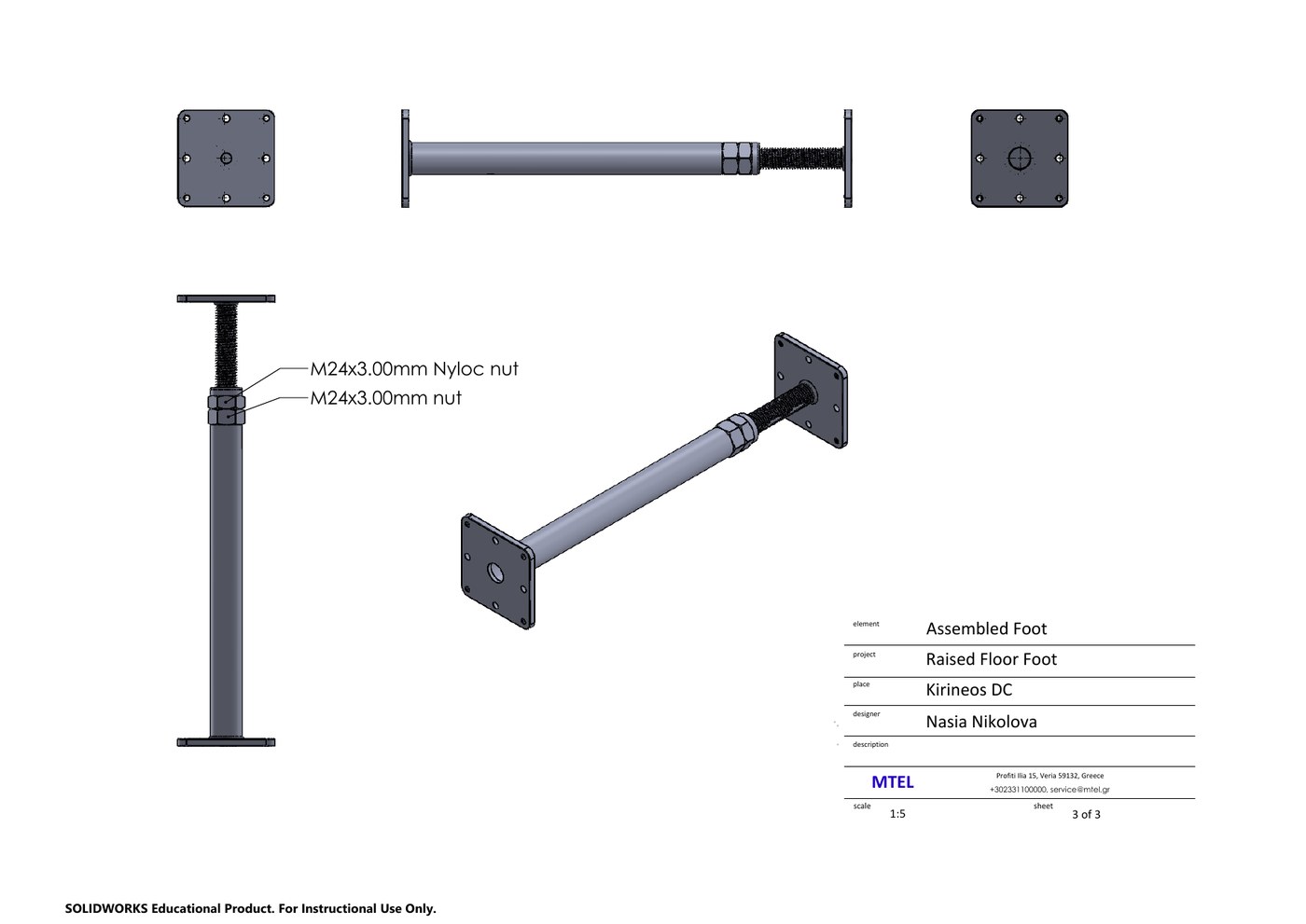
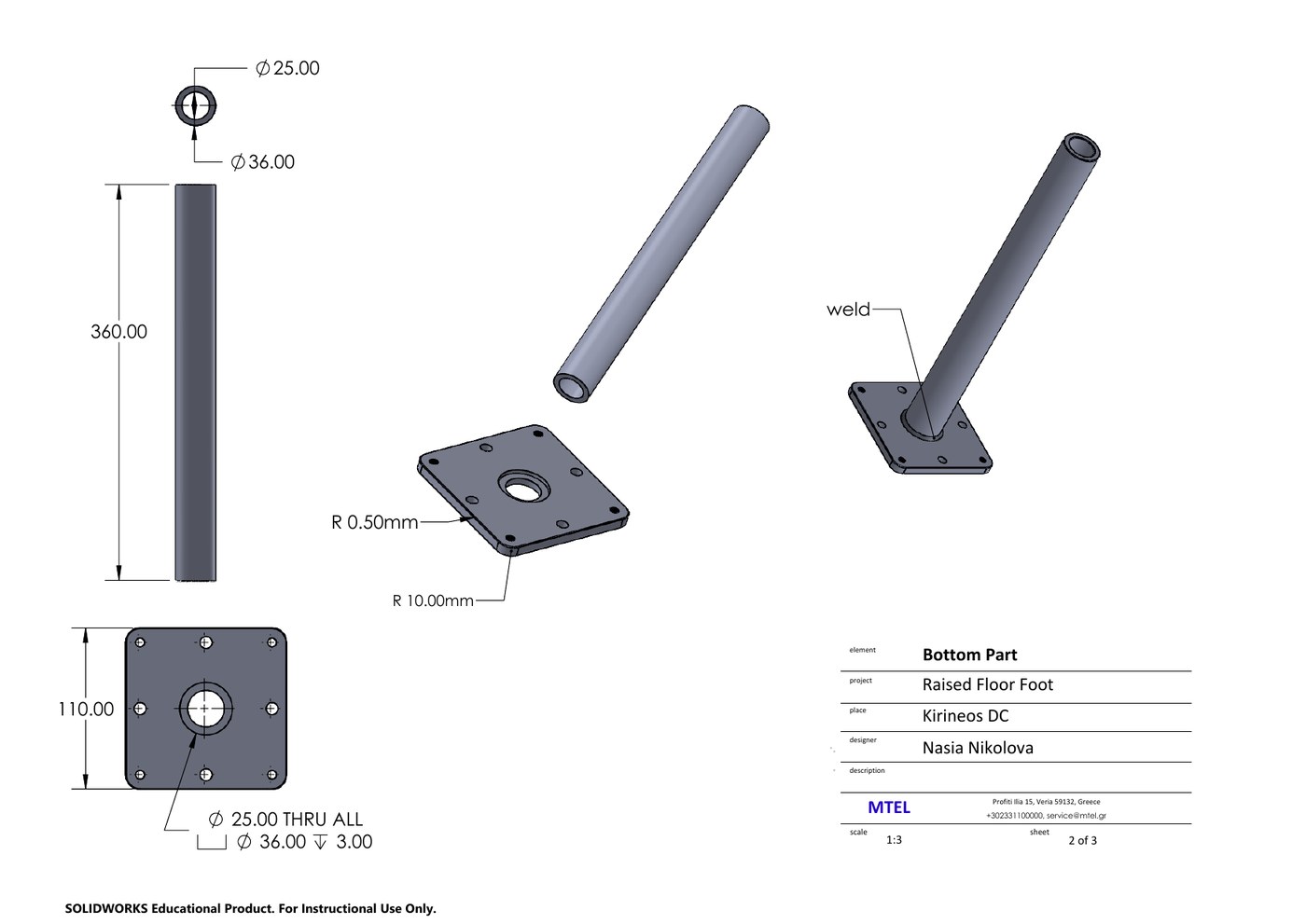
Raised Floor Foot

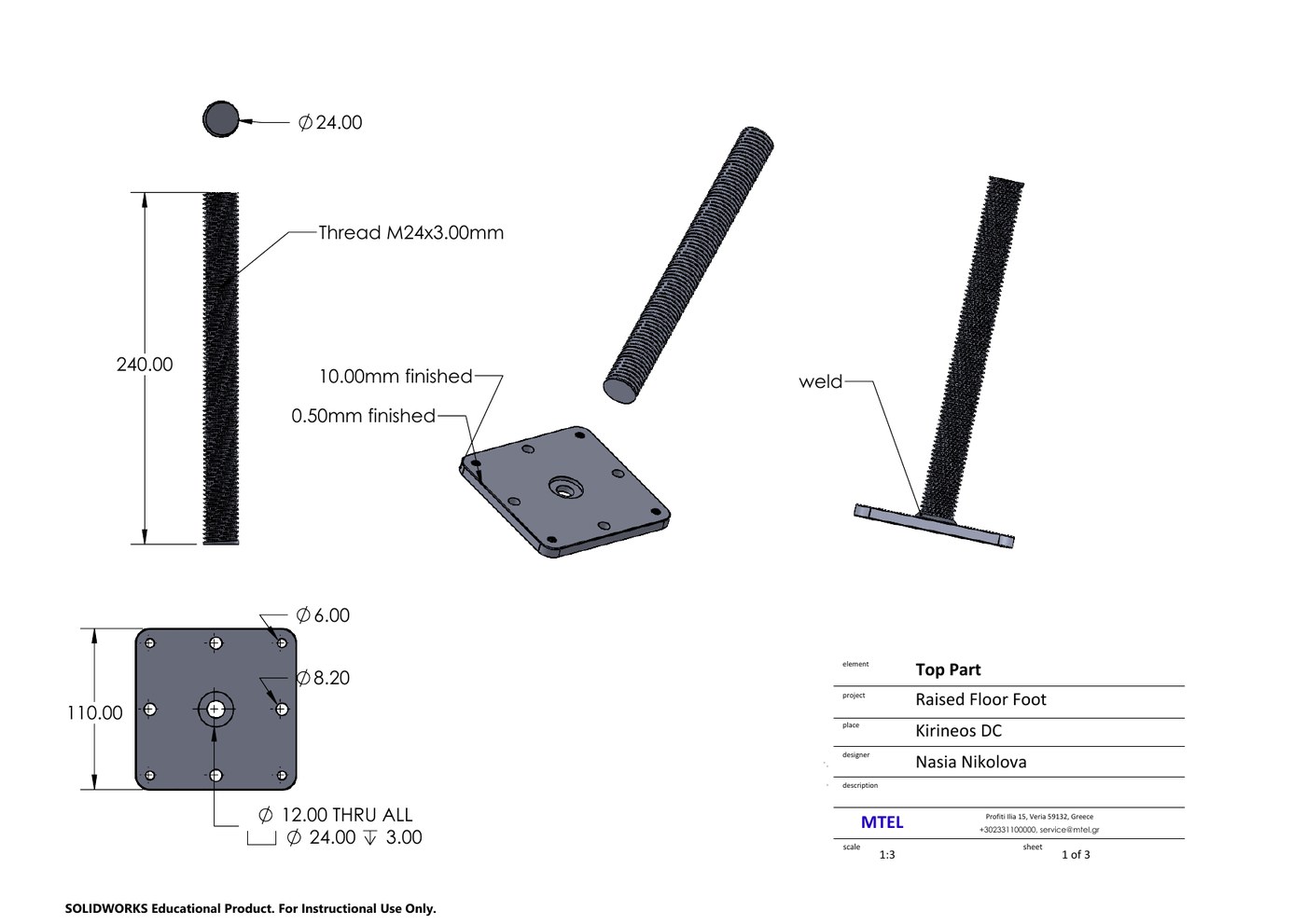
A height-adjustable pedestal that carries the raised access floor of the data hall. Server rooms run power, cooling and cabling underneath the floor, so every panel sits on feet like these. Each one has to take the load of the racks above it and still be adjustable on site to level the floor.

Assembled110 × 110 × 512 mm
BottomØ36 / Ø25 tube, 360 mm, welded to a 110 × 110 mm plate
TopM24 × 3.00 rod, 240 mm, welded to a matching plate
LockingM24 × 3.00 nut plus Nyloc lock nut
PlateØ25 through, Ø36 counterbore 3 mm, R10 filleted corners

The two halves telescope, and the pair of nuts sets and then locks the height. Using a Nyloc as the second nut matters here: a plain nut can work loose under the constant low-level vibration of cooling fans and rack equipment.

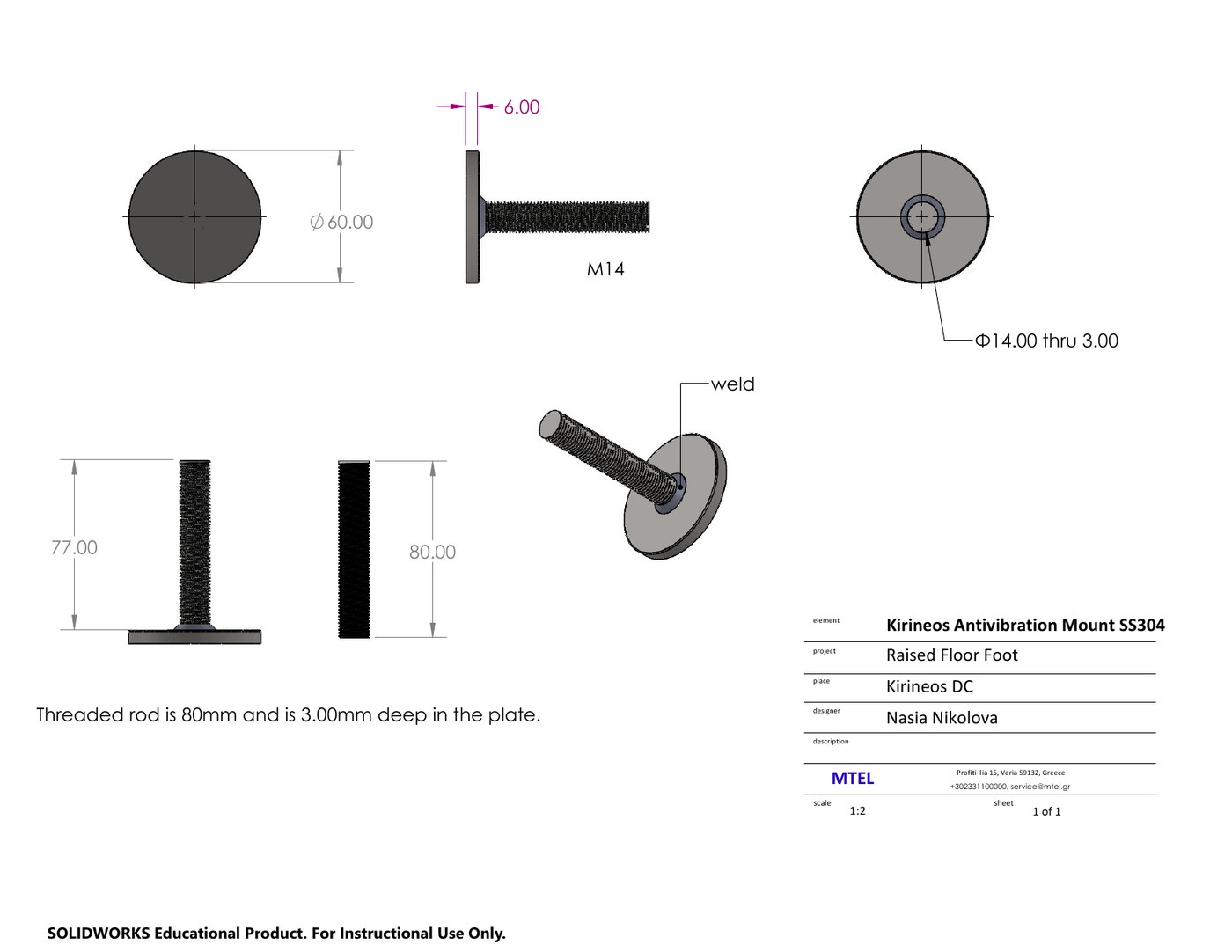
Antivibration Mount, SS304

The part that sits between the floor foot and the slab. Racks and cooling plant vibrate continuously, and vibration travelling into the structure is both a noise problem and a long-term reliability problem for spinning disks. This mount interrupts that path.

PlateØ60 × 6 mm
RodM14, 80 mm
JointRod seated 3 mm into the plate, then welded
Overall60 × 83 × 60 mm
MaterialStainless steel 304

The rod is counterbored 3 mm into the plate. That gives the weld a shoulder to sit in and keeps the rod square to the plate, which is what stops the mount loading unevenly once it is under a rack.

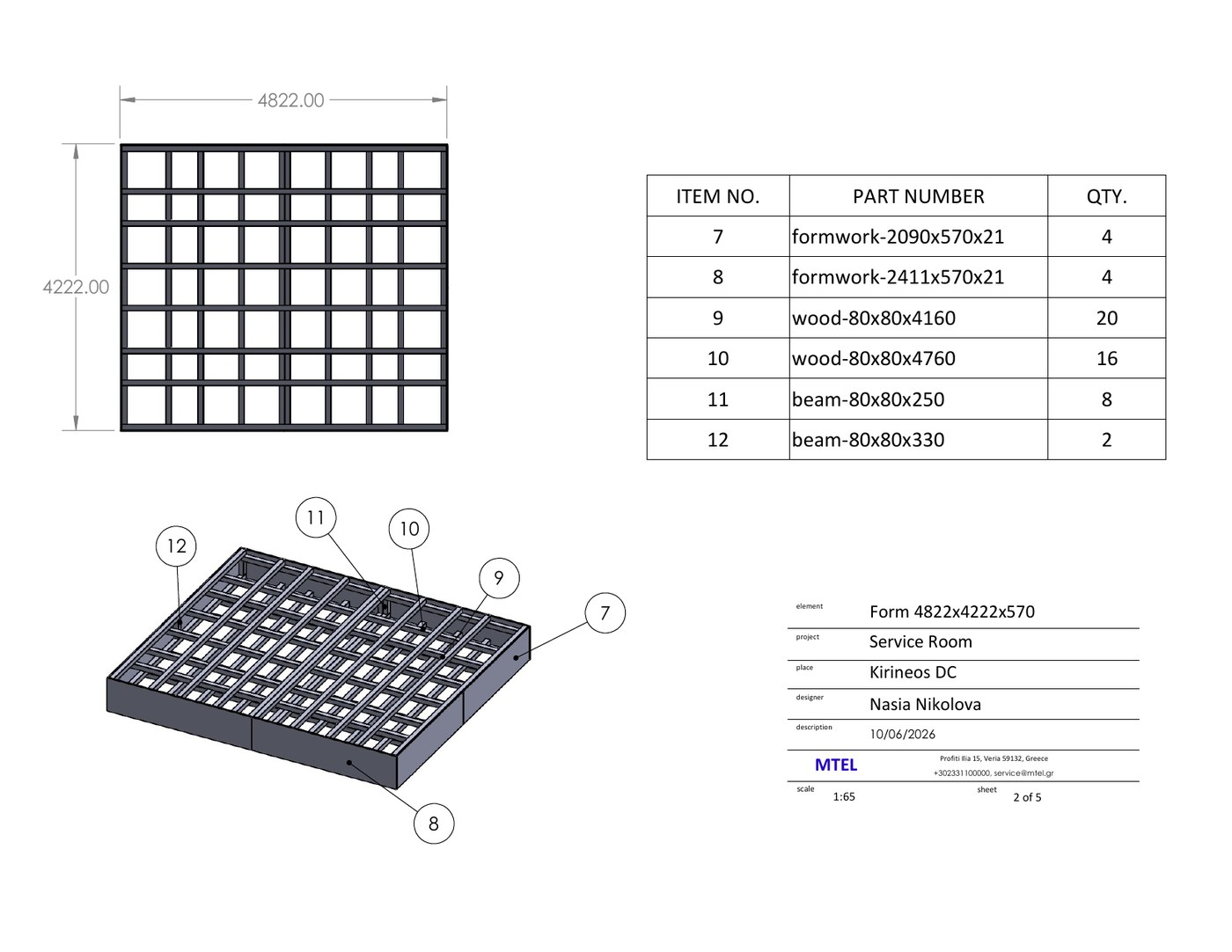
Service Room Formwork — 4822 × 4222 × 570 mm

The timber mould that the service room floor slab is poured into. It has to hold the shape of several tonnes of wet concrete without deflecting, then come apart cleanly afterwards, which is why it is a grid of standard timber sections rather than one built object.

Footprint4822 × 4222 mm
Depth570 mm
Pieces54, across 6 part types
DrawingSheet 2 of 5, scale 1:65

The bill of materials resolves to six repeated parts: 20 timbers at 4160 mm and 16 at 4760 mm in 80 × 80 section, eight 250 mm and two 330 mm blocking pieces, and eight formwork panels in two lengths. Holding it to six part types is the point — a site crew can cut and assemble that, and the drawing schedules exactly how many of each to bring.

Piping Distribution Loop

A welded steel distribution loop running roughly 5.9 × 4.5 m, with a DN32 ring feeding DN25 branches off it. The largest assembly in the set: 58 components across 14 types.

Main line32 × DN32 pipe, Ø42.4 × 2.6 mm wall
Branches11 × DN25 pipe, Ø33.7 × 2.6 mm wall
FittingsButt-weld tees, reducer, 90° elbow and weld-neck flanges to EN 10253 and DIN 2605
ValveDN32 ball valve
PumpGrundfos MAGNA3 32-80, stainless, PN 6/10, with control box
Extent4516 × 1158 × 5913 mm

Every tee, reducer and elbow here is a stock part with a catalogue number, so the assembly can be priced, ordered and welded by a contractor without anything being fabricated one-off.

Software

Financial Dashboard Project
MITxPRO capstone

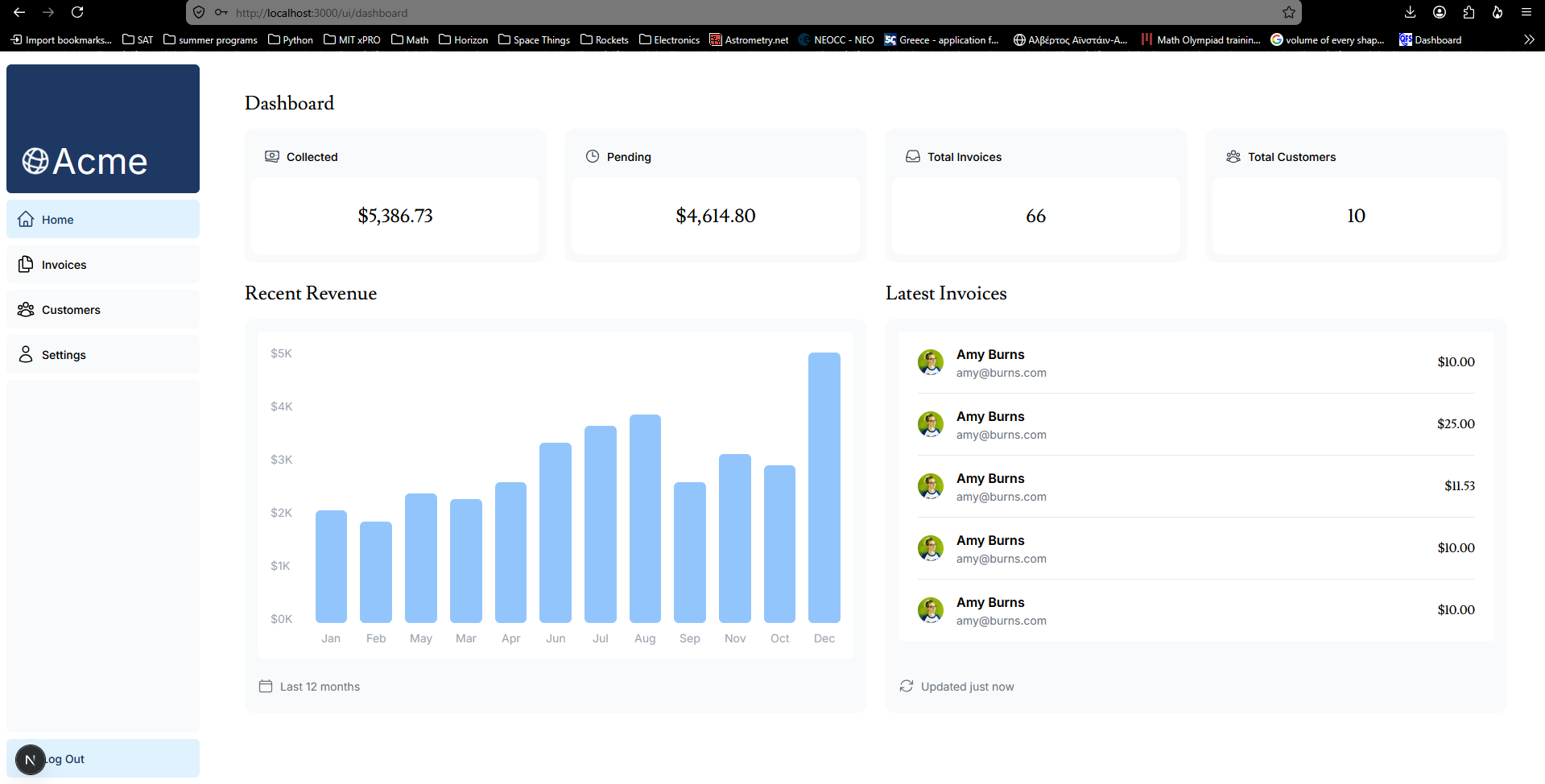
Full-Stack Invoices Dashboard

My capstone for the MITxPRO Professional Certificate in Coding: Full Stack Development with MERN — a 26-week remote programme with a deliverable every week.

The application handles authenticated login, paginated and searchable invoice and customer tables, create and edit forms validated server-side, and a revenue chart, all against a real Postgres database.

Health Dashboard Project

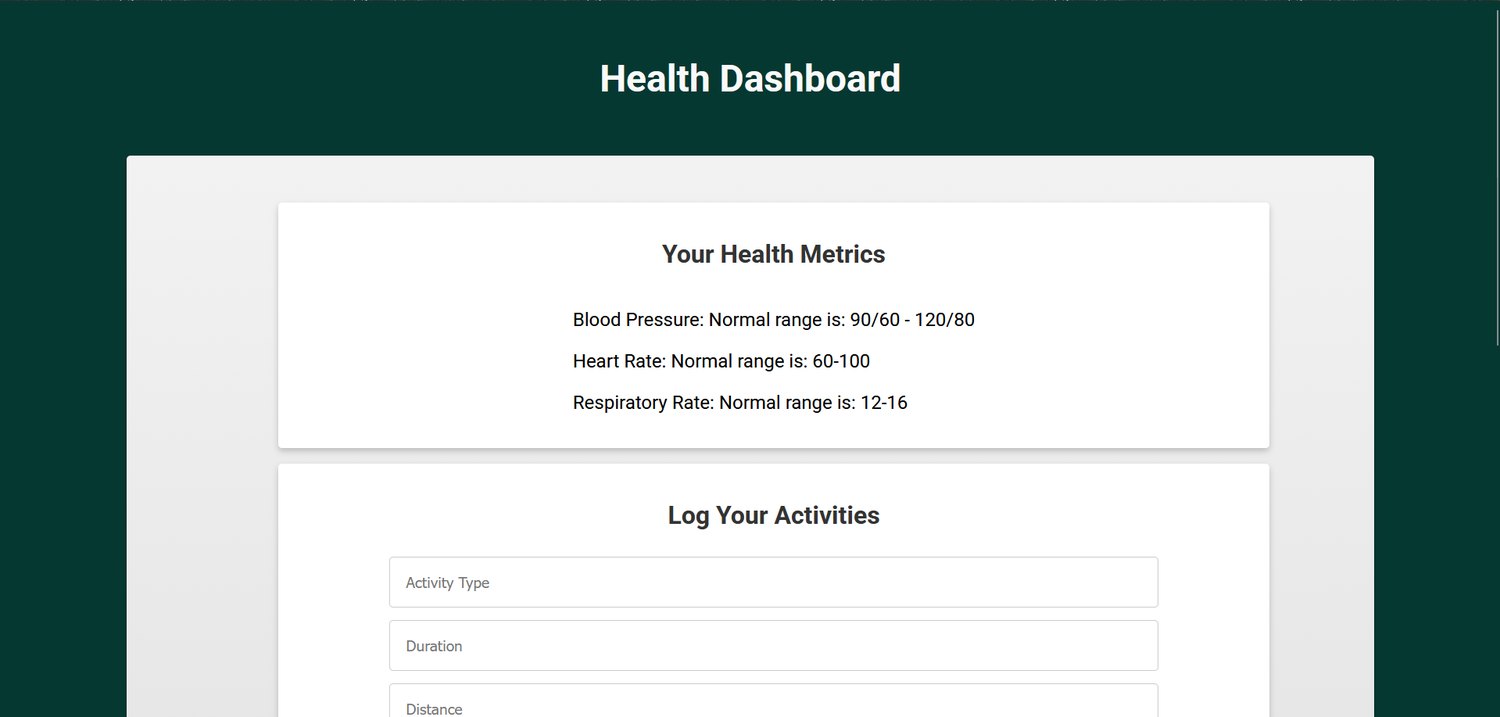
Health Dashboard

This project is an interactive health‑tracking dashboard that lets a user manage different parts of their daily wellness. It focuses on three main areas: health metrics, physical activities, and nutrition goals.

SATWORDS Project

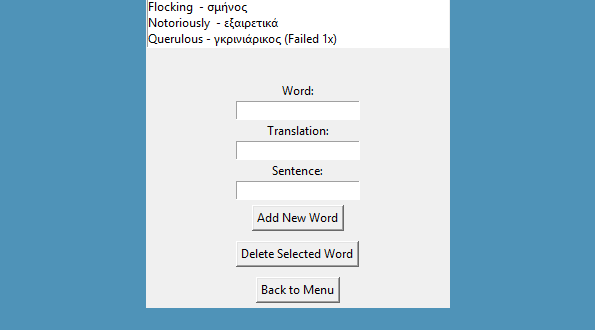
SATWORDS

This project is an application designed to prepare the examinee for SAT vocabulary. Through this program, the examinee will be able to independently verify whether they have properly learned the new words they recently encountered. The examinee can choose the words they want to be tested on and, after each test, receive immediate feedback on any mistakes.